Kakobuy Rain Commuter Shoe Grip Guide
Kakobuy Rain Commuter Shoe Grip Guide
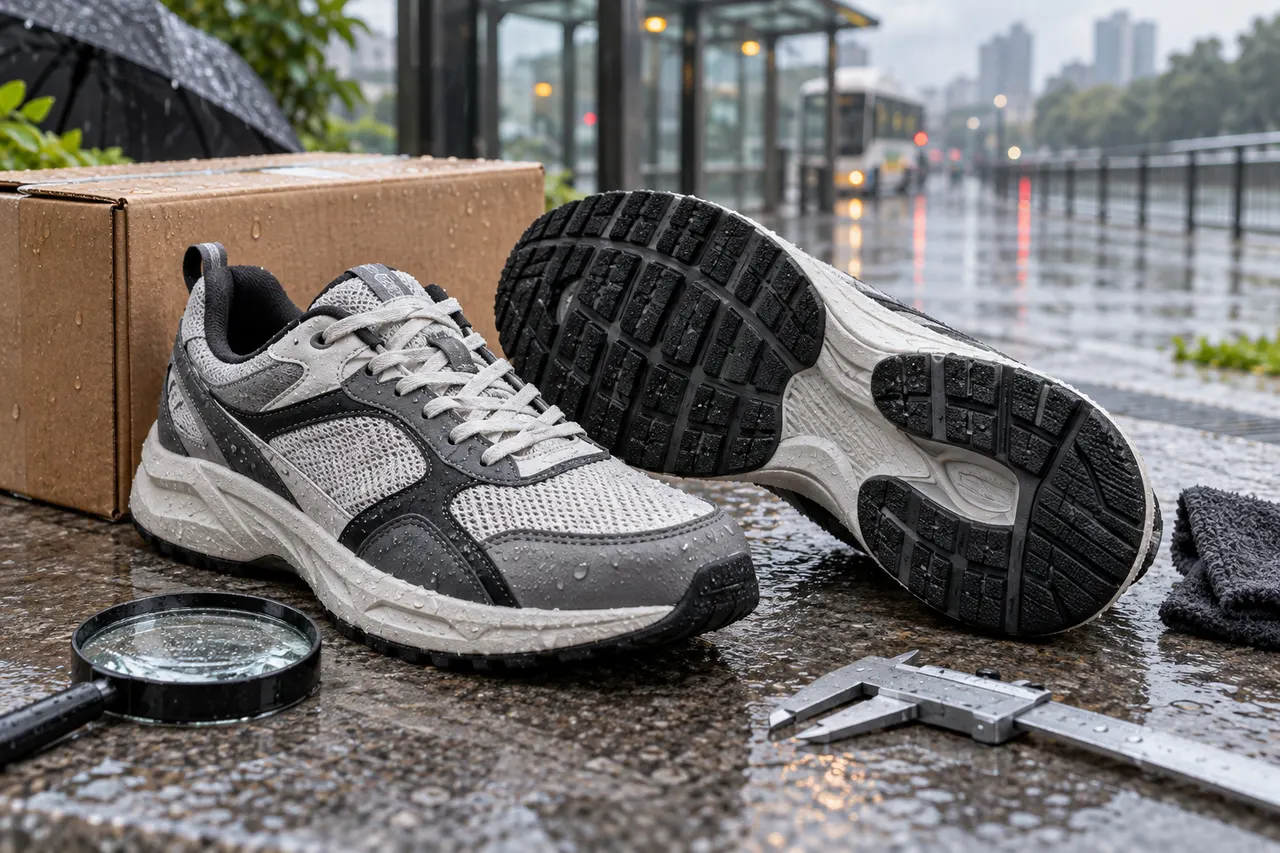
When buying athletic shoes for rainy-day commuting, the real issue isn't "which pair looks best," but whether the shoes can stay stable on wet ground, subway platforms, tiled entrances, crosswalk markings, and stair edges, and whether they can withstand the daily sole wear from repeated walking. As a Chinese shopping agent, freight forwarder, and quality inspection service platform, kakobuy can help users order products from Chinese e-commerce platforms and provide appearance-based QC photos for verification after the items arrive at the warehouse. This article only discusses what can be judged through product page information, seller images, sole images, and QC photos before ordering and after warehousing. It does not present photo observations as real wear tests.
This article is suitable for users who are preparing to buy rainy-day commuter athletic shoes through kakobuy, need to screen candidates before payment, or want to determine after warehousing whether to request additional photos, return/exchange, or continue shipping. It is not suitable for situations that require professional slip-resistant certified shoes, work environments with oily floors or industrial safety requirements, or when the shoe model is confirmed to lack sole images and the seller cannot provide additional photos.
Verification scope: This article is compiled based on the platform information already provided by kakobuy, its agent fee structure, QC inspection boundaries, and warehouse return/exchange rules. Prices, inventory, sizes, seller commitments, international shipping costs, and route restrictions are all highly volatile information. Before ordering, you should refer to the product page, kakobuy order page, and customer service replies. The verification date is recommended to be recorded as the actual order date.
First define the road surfaces and walking duration of rainy-day commuting
Judging rainy-day commuter shoes should start from your actual route, not from words like waterproof, running, or outdoor in the shoe name. Most urban commuting is not continuous muddy ground or mountain trails, but a series of alternating wet and slippery surfaces: residential stone paths, subway entrance tiles, bus stop metal edges, crosswalk coatings, mall smooth floors, and office stairs.
If you walk less than 15 minutes a day, basic sole tread, heel stability, and low water absorption of the upper are usually more important than extreme grip. If you walk more than 30 minutes a day, especially pay attention to the wear-resistant design of the forefoot flex zone and the outer heel, because these two positions will wear flat more quickly during long-term commuting. If the route includes long slopes, pedestrian bridges, underpasses, or extensive smooth tiles, you need to raise the grip requirements. It is not advisable to choose styles with very small outsole contact area, shallow tread, and smooth sole edges.
You can first divide your route into three categories:
Low risk: short distance, mainly sidewalks, and rainy days are only slightly wet.
Medium risk: a mix of subway, mall, stairs, and outdoor roads, walking 15–40 minutes.
High risk: many slopes, many tiles, often rushing to catch a vehicle, or needing to carry a laptop bag or luggage while commuting.
This classification will directly affect whether you accept a shoe's outsole design later. Rainy-day shoes are not safer just because they are thicker, nor more slip-resistant just because they are softer; the key is whether the outsole material coverage, tread drainage, contact surface distribution, and wear-prone areas match your route. ☔
What kakobuy can help verify about shoe information
When purchasing shoes through kakobuy, users usually first submit product information from Chinese e-commerce platforms, and kakobuy assists with the purchase. After the goods arrive at the warehouse, quality inspection is carried out. kakobuy's inspection mainly targets appearance information such as style, quantity, color, size, and model. For footwear, QC photos can be used to check visible appearance, but QC cannot replace actual rainy-day try-on or prove the actual friction coefficient of the sole on a specific surface.
In other words, the most valuable verification points for rainy-day commuter shoes through kakobuy are:
Whether the product page has clear sole images, side images, heel images, and toe images.
Whether the seller images show the outsole material, tread depth, drainage groove direction, and contact surface.
Whether the warehouse QC photos can show left and right soles, sole edges, glue overflow, and obvious upper defects.
Whether size, color, and style match the order.
If images are insufficient, whether additional photos can be requested or after-sales processed within the return window.
Note that kakobuy's 5-day no-reason return/exchange period is usually calculated from 120 hours after warehousing, and special items may not be applicable. Items where the warehouse has removed packaging, tags, or accessories may also affect returns/exchanges. If your decision on rainy-day commuter shoes mainly depends on QC, it's best to look at the photos as soon as the items are warehoused, rather than waiting until you're about to consolidate and ship to discover that the sole tread is unsuitable.
In terms of costs, the total agent cost generally includes product cost, domestic shipping within China, international shipping, and customs declaration fee. kakobuy's example customs declaration fee is generally about RMB 8, but this still depends on the shipping method. International shipping costs vary by weight, route, and destination, so it's not advisable to blindly choose particularly heavy shoe models just because they "might be more slip-resistant"; when shoe weight increases, the actual total cost may exceed the price difference of the product itself.
Judge basic grip requirements on wet surfaces from outsole coverage area
When looking at the sole, don't rush to judge whether the tread looks good. The first step is to see the outsole coverage area: how much of the key areas actually contact the ground with rubber or wear-resistant material.
Basic grip for commuter athletic shoes should at least cover three positions: the heel strike point, the forefoot push-off area, and the contact edge after the toe is slightly upward. If the product image shows that a large area of the sole is exposed midsole foam, with rubber patches only in a small area, this design may be lighter, but it carries higher risk on wet slippery surfaces and under long-term wear. Especially for rainy-day commuting, the heel and forefoot cannot rely on scattered small blocks alone.
Outsole shapes that are more worth prioritizing include:
Continuous wear-resistant patch on the outer heel, suitable for a heel-strike gait.
Relatively complete transverse coverage on the forefoot, more stable when walking on stairs and starting on wet ground.
The middle of the sole is not excessively suspended, reducing uneven contact when turning or avoiding laterally.
Some wrapping on the toe front edge, more wear-resistant when kicking steps or curbs on rainy days.
Outsole shapes that require caution include:
The sole looks thick, but the actual ground-contact rubber is only in a few small blocks.
A large smooth area in the middle of the forefoot, with tread concentrated on decorative edges.
No obvious wear-resistant coverage on the outer heel, or the edge is designed very thin.
Sole images only show angled beauty shots, making it impossible to see the full contact surface.
If the product page does not have a complete sole image, you can treat the shoe as one risk level higher before ordering. For low-risk short commutes, it may still be acceptable; for medium or high-risk rainy-day routes, it is recommended to change candidates or ask the seller to supplement sole images if communication is possible.
Check whether tread depth, drainage grooves, and contact surface match commuting scenarios
Rainy-day grip is not just about having lots of tread, but also whether the tread can drain water and maintain stable contact on wet surfaces. Too shallow tread is prone to wearing flat quickly; too dense small tread may trap dirt in muddy or fine gravel environments; a completely smooth outsole may be comfortable on dry indoor floors, but the risk is higher when entering subways or malls on rainy days.
When judging, look at three dimensions: tread depth, drainage groove direction, and contact surface distribution.
Checkpoint | Performance more suitable for rainy-day commuting | Performance requiring caution |
|---|---|---|
Tread depth | Clear grooves on forefoot and heel, edges not just decorative lines | Very shallow tread that still looks like embossing when zoomed in |
Drainage grooves | Transverse or diagonal grooves that can channel water away from contact areas | Large enclosed circular or decorative patterns with unclear drainage paths |
Contact surface | Evenly distributed raised blocks, complete forefoot push-off area | Hollow center and thick edges, unstable actual contact area |
Wet surface adaptation | Heel, forefoot, and toe all have tread engaging the ground | Only the edges have patterns, the middle is almost flat |
Rainy-day urban commuting does not necessarily require aggressive outdoor lug soles. Too high, too hard, and too widely spaced lugs may actually result in insufficient contact area on smooth tiles. A safer commuting choice is usually soles with medium-depth tread, continuous drainage grooves, and actual contact blocks on both forefoot and heel.
Also check the left-right direction. Some sole images show diagonal tread; if the left and right shoes have appropriately mirrored tread direction, that is normal design. If the warehouse QC shows clearly inconsistent left and right sole tread, missing blocks, misplacement, or edge separation, consider requesting additional photos or after-sales service. 🚇
Mark the wear-prone areas at toe, outer heel, and forefoot flex zone
Wear on rainy-day commuter shoes does not occur evenly. Most users wear down three positions first: the outer heel, the area near the big toe on the forefoot, and the toe front edge. Before ordering, when looking at product images, focus on these three positions as key inspection areas.
The outer heel determines daily wear from landing. If the rubber coverage on the outer heel is thin and the edge is sharply tapered, long-term walking may cause faster uneven wear. The forefoot flex zone determines durability during push-off, stair climbing, and rushing. If the tread in this area is cut too finely or the midsole material is largely exposed, it may first show flattening, glue failure, or depressions later. The toe front edge affects protection when kicking steps, curbs, or bus pedals on rainy days.
The inspection method can be simple:
Zoom in on the sole image to see if the outer heel has continuous rubber and clear tread.
See if the forefoot near the flex line has complete support, not overly fragmented by decorative grooves.
See if the toe front edge has upward wrapping or wear-resistant coverage.
See if the connection between the sole and upper is smooth, without obvious glue overflow, edge lifting, or gaps.
If seller images are heavily retouched, treat that as "possibly uncertain," not as a verified advantage.
After warehousing, QC photos can help confirm whether these areas have obvious appearance issues, but they cannot tell you what will happen after several months of wear. A more practical approach is to treat QC as a tool to "eliminate obvious risks," not as evidence of "durability." 👟
Use QC photos to check left-right sole tread, glue overflow, and edge bonding
After goods arrive at the kakobuy warehouse, users should check QC photos as soon as possible. For rainy-day commuter shoes, the usual front, side, and box photos are not enough; it's best to see sole and heel details. If the system photos do not cover key sole areas, consider requesting additional photos based on the platform's available services before deciding whether to continue shipping.
QC checkpoints are as follows:
Whether the left and right sole tread is consistent, with no obvious misprint, missing parts, or severe deformation.
Whether the sole edges are bonded properly, especially at the toe, heel, and forefoot flex zone.
Whether there is large-area glue overflow, edge lifting, openings, or obvious pressure marks.
Whether the size label, color, and style match the order.
Whether the box and accessories match the product page description, but do not equate intact packaging with the shoe being suitable for rainy days.
If there is only minor glue overflow and it is not in a flex stress area, the risk may be low; if glue overflow is accompanied by edge unbonding, sole lifting, or obvious left-right asymmetry, it should not go directly into international shipping. Because once shipped internationally, after-sales cost and time increase, and the return window may have been missed.
Also consider kakobuy's warehouse storage period. The regular free storage period is 100 days, and for abnormal parcels it is 60 days; but the after-sales decision for rainy-day commuter shoes should not be delayed until near the storage deadline. The real key is whether return/exchange can still be processed within 120 hours after warehousing, and whether the item belongs to a special category that does not support returns/exchanges. 🕒
Build a pre-order checklist for rainy-day commuter shoes
Before ordering, use a simple checklist to separate subjective preferences from actual risks. It is recommended not to pay directly just because of coupons, popular models, or attractive seller images. kakobuy's new-user shipping discount coupons and exclusive shipping discount codes can reduce some shipping costs, but they cannot reduce the risk of a sole unsuitable for rainy days.
Item | Pass standard | Action if not passed |
|---|---|---|
Route risk | Confirmed as low, medium, or high risk commuting route | First define walking duration and wet slippery surfaces |
Sole image | Complete, clear, unobstructed outsole image | Request additional photos or change candidates |
Outsole coverage | Wear-resistant coverage on heel, forefoot, and toe key areas | Not recommended for high-risk routes |
Tread drainage | Groove direction and depth support water drainage on wet surfaces | Downgrade to dry or short-distance candidate |
Wear-prone areas | Reasonable design of outer heel and forefoot flex zone | Focus on QC after warehousing or give up |
Return window | Understand the 120-hour processing limit after warehousing | Look at photos immediately upon arrival, don't delay |
Total cost | Product price, domestic shipping, international shipping, and customs fee all estimated | Don't just compare product list prices |
If a shoe is satisfactory in appearance, size, and price, but has no sole image, that is not a minor issue. For rainy-day commuting, the sole image is core decision information. For low-risk short-distance users, it can be listed as "buy after supplementary photos"; for high-risk route users, it is recommended to change to a candidate with more complete information.
Finally decide to buy, request photos, or change candidates based on risk level
The final decision can be made by risk level; you don't need to pursue perfection for every shoe. The focus is on avoiding bringing clearly unsuitable shoes for rainy-day commuting into international shipping.
Low-risk routes can accept more information gaps: for example, very short walks, mainly indoor and dry corridors, as long as the outsole tread is not largely smooth and the product page and size information are clear, you can continue observing. But after warehousing, still check the sole QC to confirm no obvious glue failure or misprint.
For medium-risk routes, raise standards: you must have a complete sole image, continuous tread on heel and forefoot, and the sole edge cannot rely solely on decorative shapes. If warehouse QC lacks sole angles, request additional photos before deciding to ship.
For high-risk routes, be more conservative: if you often walk on wet slippery tiles, slopes, stairs, or rush to catch commuter vehicles, do not buy styles with shallow sole tread, unstable contact surface, and weak outer heel coverage. Even if cheap, it may become a higher cost in terms of international shipping, waiting time, and after-sales difficulty.
A practical conclusion is: rainy-day commuter shoes are worth spending a little more time screening for clear sole information and a more reliable outsole structure, but not worth bearing international return costs for unverified "non-slip" or "wear-resistant" claims. When buying through kakobuy, first use the product page to rule out insufficient information and structural risks, then use QC photos to rule out obvious appearance problems, and finally consider consolidation, route, and shipping.
The savings mainly come from buying fewer unsuitable shoes, reducing repeated international shipping, and avoiding missing the return window; the increased risk is longer screening time, possible need for additional photos, or paying a higher product price by giving up cheap candidates. Suitable for buyers who have a fixed daily commute and are willing to look at sole images and QC details. Not recommended for scenarios where you need occupational safety slip-resistant shoes, medical corrective shoes, or must rely on actual try-on to judge fit. 🌧️
Agent Platform Shopping FAQ
1. What should I do if I am not happy with the item I received through kakobuy?
Reach out to kakobuy's support team as soon as you can. Most non-specialty goods from Chinese sellers have a 5-day return policy that doesn't require a reason. If you want to send something back because you're unsatisfied, you can ask for a return. If the item has already been shipped from the kakobuy warehouse and delivered to you, and you find a defect, contact kakobuy's support staff so they can assist you in talking to the seller and arranging a solution.
Here are the support email addresses for kakobuy and other platforms:
kakobuy: [email protected]
oopbuy: [email protected]
usfans: [email protected]
hipobuy: [email protected]
superbuy: [email protected]
2. What are QC photos, and how does kakobuy use them?
kakobuy has a dedicated quality control team. When your products reach the kakobuy warehouse, the team inspects them and takes QC photos. They usually take three pictures and check that the color, size, specifications, and quantity match your order, and they look for any quality problems. Electronics are only checked for their outer appearance. If they find defects or wrong size or color, they immediately ask the seller for a return. This process helps ensure you receive good-quality items.
3. What should first-time kakobuy users pay attention to?
When you first use kakobuy through the spreadsheet to buy from Taobao, you usually get a new-user shipping discount package. You should also check the beginner's step-by-step shopping guide.
4. How can I tell if a product is good quality when shopping with kakobuy?
To judge product quality, look at the QC photos from kakobuy. Don't just rely on factory photos because they are often retouched. Use the QC photos to see if the product meets your specific requirements for details before you decide to buy it.
Also, avoid items with very low prices because they usually aren't very good quality.
Browse our latest products and find your next favorite item.